What a landing net does on the water
A landing net gives you a safer final step when a fish is close to hand. Instead of hauling a fish by the line or trying to lip a strong, thrashing fish over a gunwale, you guide it into the mesh and lift with control. That matters for leader knots, hooks, and the fish itself, especially when you are fishing off rocks, from a ski-boat, or along a high bank where one bad move can mean a lost fish or a damaged rod.
For coastal anglers in Durban and the KZN North Coast, a net also helps with species that kick hard at the boat side and can twist the trace. Freshwater anglers use them for bass, carp, barbel and tilapia where bank height, reeds or muddy ground make a clean landing difficult. The right net saves time and reduces the chance of a dropped catch, which is why it belongs in every serious tackle kit.
- Safer fish handling for catch and release
- Less strain on line, knots and rod guides
- Better control in boats, on rocks and on steep banks
- Useful for shore, dam and estuary fishing
Net sizes and handle options we stock
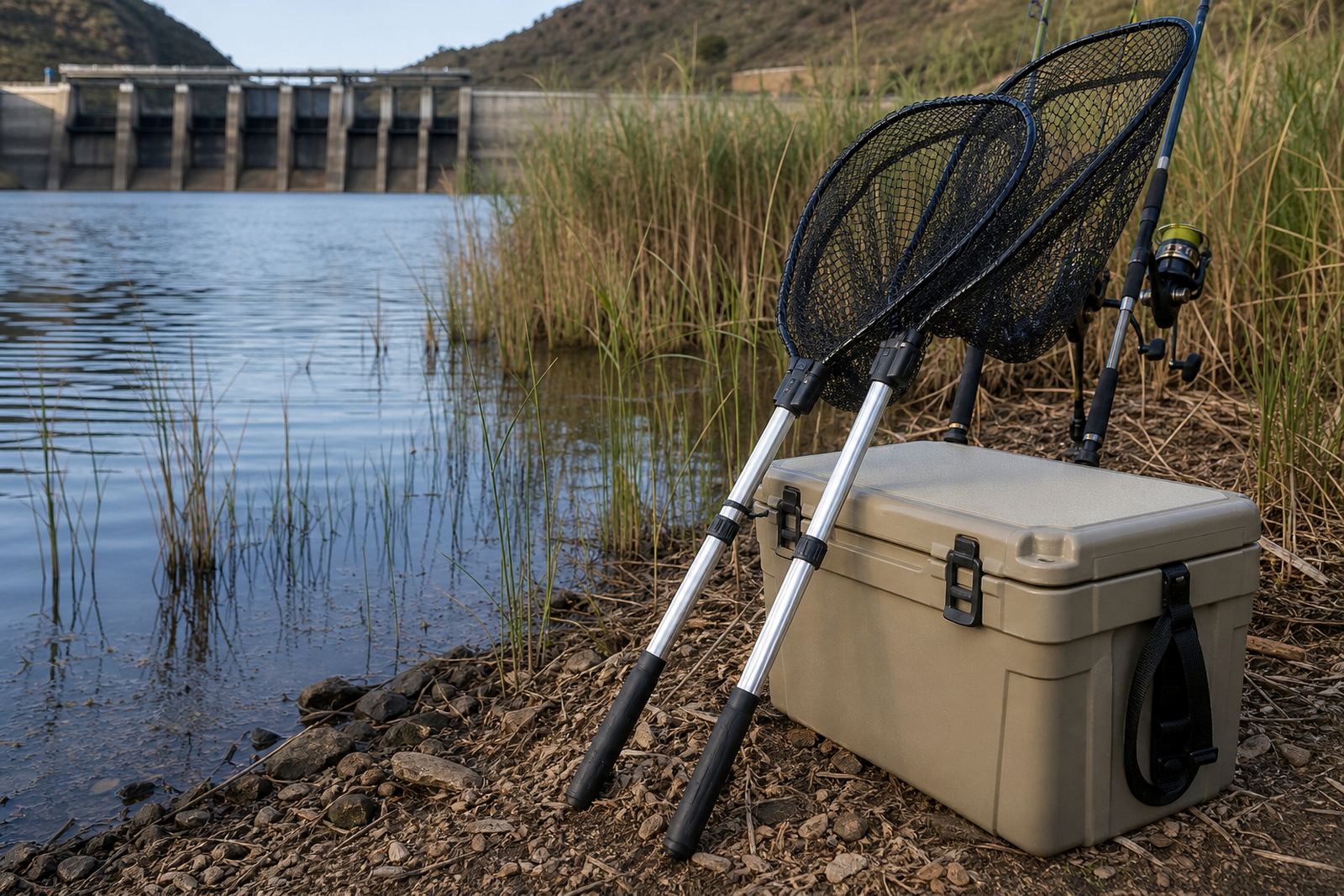
Landing nets are usually chosen by hoop size, handle length and mesh type. A compact net is handy for kayak fishing, estuary banks and quick boat work, while a larger hoop helps when you are landing bigger fish or working with a partner. Handle length matters too. Short handles are neat in a boat, medium handles suit mixed use, and long handles are better for rock fishing or steep freshwater banks where reach is important.
Mesh choice affects both fish care and ease of use. Fine mesh is kinder on scales and fins, while rubberised or coated mesh tends to snag less and is easier to rinse after saltwater use. Some anglers prefer a deeper bag for fish that jump and roll, while others want a shallower net for quick control. We also see a lot of buyers wanting foldable or telescopic handles because they store easier in a bakkie, rod tube or ski-boat hatch.
- Hoop sizes commonly suited to 40 cm, 50 cm and 60 cm class fish
- Short, medium and long handles depending on fishing style
- Foldable and telescopic options for easier transport
- Mesh options for saltwater, freshwater and catch-and-release use
Where landing nets suit best
Landing nets suit almost every fishing setup, but the best choice depends on where you fish most. Coastal anglers working rocks around Durban, East London or Cape Town often need extra reach to keep hands clear of wash and slick surfaces. On charter boats and ski-boats, a net with a steady handle and a wide opening helps when a fish comes boatside at an awkward angle. In freshwater, a lighter net is often enough for bass and carp, while river anglers may want something with a stronger frame for currents and snags.
If you fish from the bank, think about how high the edge is and how much room you have to step back. A long handle can save you from leaning too far over water and losing balance. For club anglers and competition days, having one net at the ready can speed up weigh-in and release work, especially when several rods are active at once.
- Rock fishing with spray, current and uneven footing
- Boat fishing where fish need to be guided without lifting by line
- Dam and river fishing from banks with reeds or height
- Estuary and harbour work where control matters in tight spaces
Installation, fitting and what power you need
Most landing nets do not need any power or gas. They are a manual tool, so there is no setup beyond checking that the handle locks properly, the hoop is secure and the mesh is fixed without loose stitching. If your net has a folding head or telescopic shaft, test the locking points before the trip so nothing slips when a fish is in the bag. For boat use, make sure it stores neatly and does not foul rods, gaffs or safety gear.
On some boats and kayaks, anglers use a clip, strap or holder to keep the net within reach. That is worth planning for if you fish alone or move around often. For rock anglers, a lanyard or tether can help prevent a dropped net in rough water. We often suggest checking the handle grip too, especially if your hands get wet or you fish in summer heat when grip can get slick.
- No electricity or fuel required
- Check locks, ferrules and folding joints before use
- Use a holder, strap or tether where storage is tight
- Confirm grip comfort for wet hands and long sessions
Care after saltwater, sand and mud
Landing nets work hard and they collect salt, sand, slime and mud, so regular care helps them last. After saltwater fishing, rinse the mesh and frame with fresh water as soon as you can. This is especially important on the coast where salt spray sits on gear and corrodes metal parts. If you fish muddy freshwater banks, wash grit out of the net bag before it dries hard. A quick rinse after each trip goes a long way.
Dry the net before storage where possible. Leaving a damp net bundled in a hatch or garage can cause smell, rust and tired stitching. Check the handle threads, hinges and hoop joins now and then. If the mesh is torn or the frame is bent, we recommend sorting it before your next session rather than trying to push one more trip out of it.
- Rinse after saltwater, estuary or muddy use
- Dry fully before packing away
- Check stitching, joints and handle locks regularly
- Store out of direct sun when not in use
What to check before you order
When ordering a landing net, start with your fishing style and the fish you expect to land. A net that is too small can make handling awkward, while one that is too heavy will annoy you on long sessions. Measure the storage space in your vehicle or boat and think about whether you need a collapsible model, a fixed handle, or a longer reach for shore fishing. If you fish both coastal and freshwater water, a mid-size option with a durable mesh is often the most practical pick.
Also check the hoop shape, handle length, net depth and whether the mesh suits the species you target. If you do catch-and-release, softer mesh is usually the better choice. If you are not sure, tell us where you fish, what species you target and whether the net is for boat, rocks or bank work. That makes it easier for us to point you to the right size without guessing, and it saves a second purchase later on.
- Target species and average fish size
- Fishing location: boat, rock, estuary, dam or river
- Handle length and storage space available
- Mesh type and whether catch-and-release is important
Key facts
| Product type | Landing nets for coastal and freshwater fishing |
|---|---|
| Use case | Boats, rocks, estuaries, dams and river banks |
| Handle options | Short, medium, long, folding and telescopic |
| Hoop sizes | Compact to large, suited to common shore and boat species |
| Mesh options | Fine mesh, coated mesh and softer fish-friendly styles |
| Maintenance | Freshwater rinse, dry storage, regular joint and stitch checks |